Nederlands
 Français
 Italiano

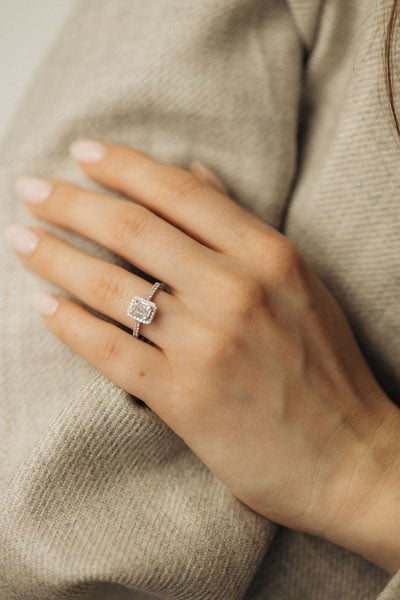

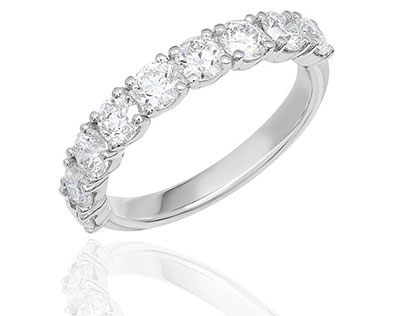

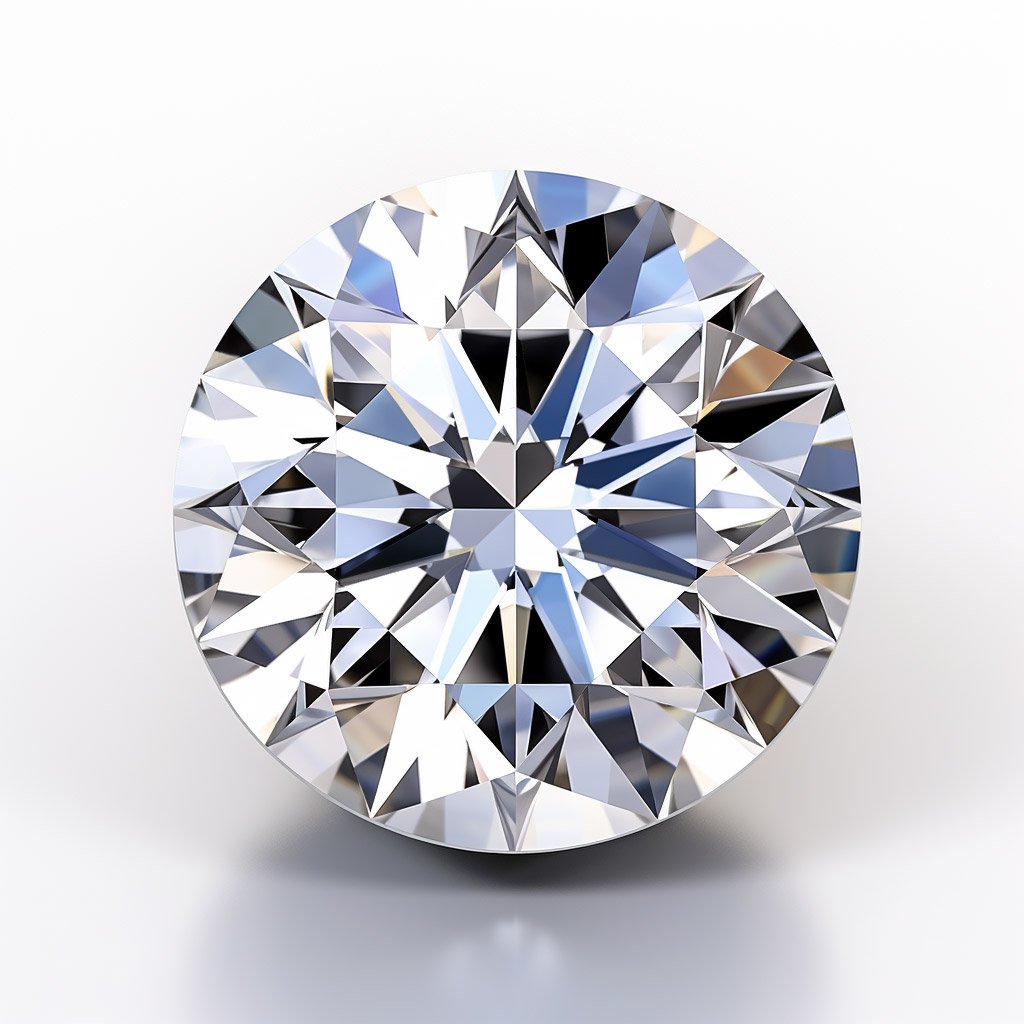


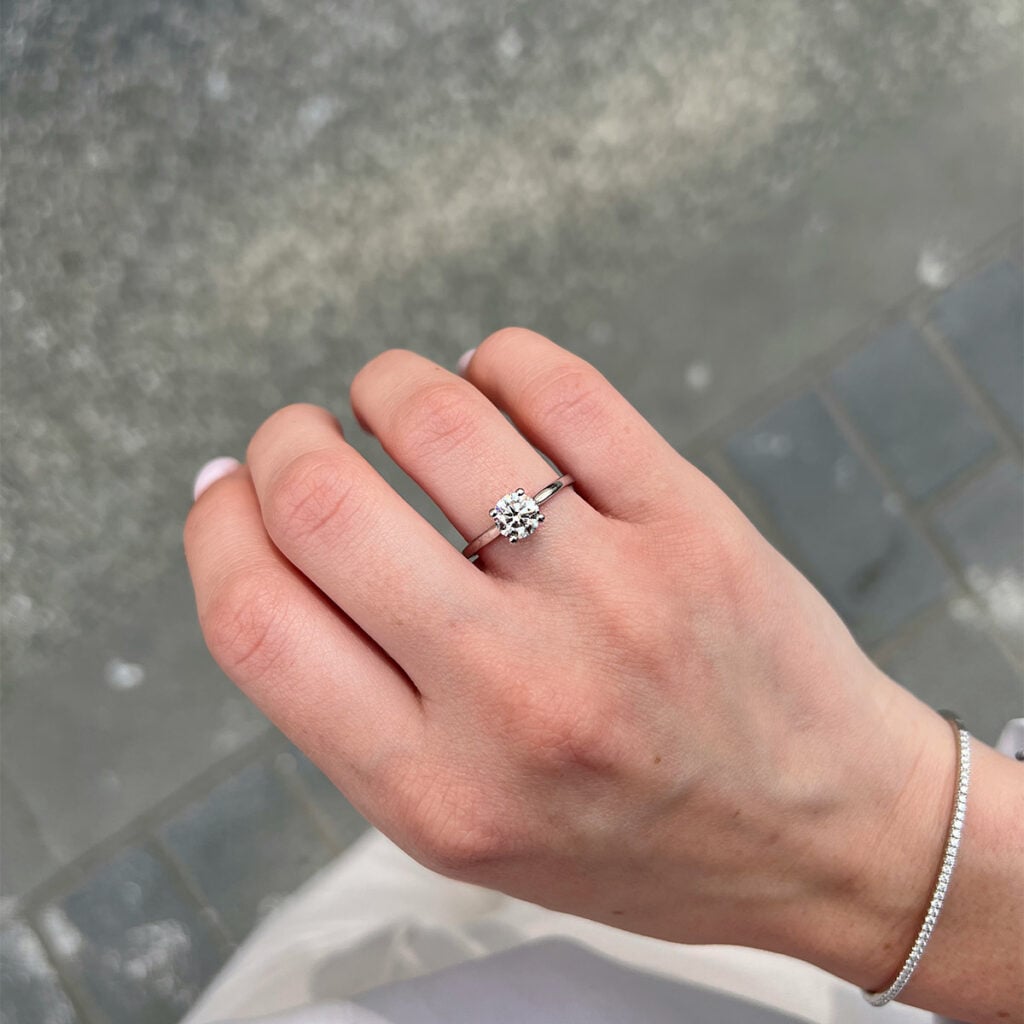
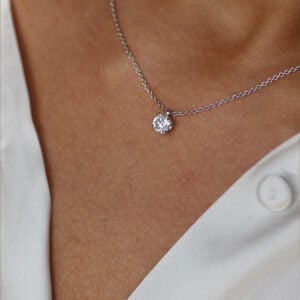
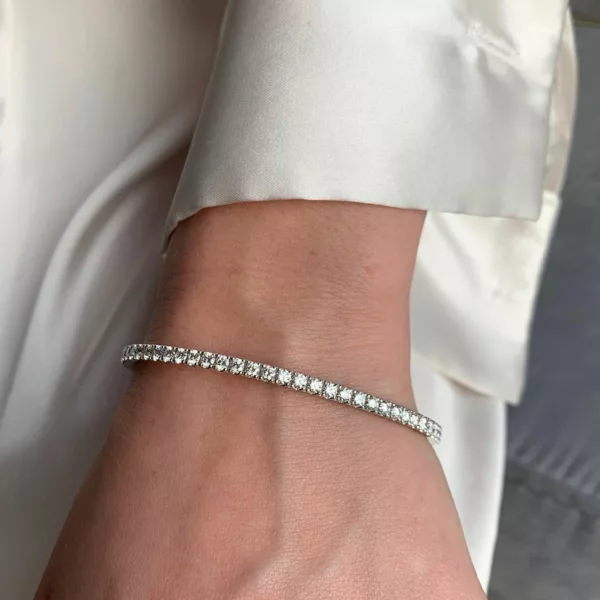


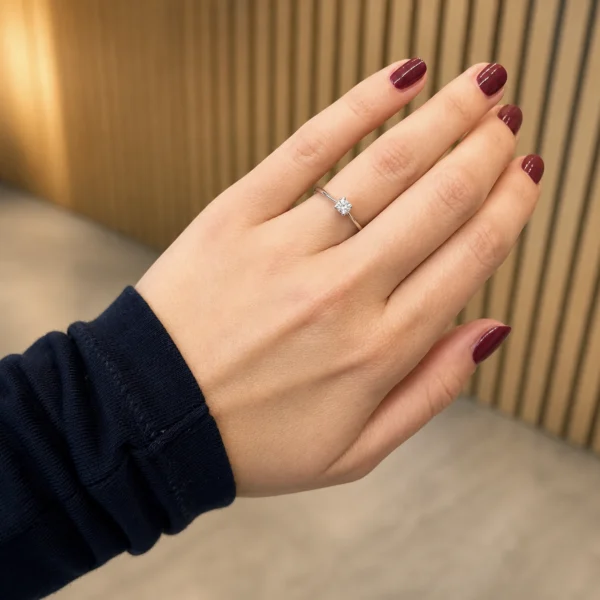
0.40 carats, round brilliant, GIA certified F colour and VS2 clarity, four claws, on a thin 18K white gold band that curves as it rises to the head. Report 6551014664.
The band is the cheapest way to make a stone look bigger
A 0.40 carat round brilliant measures roughly 4.8 mm across. That number is fixed. What is not fixed is how large it appears, because the eye does not measure millimetres — it compares the stone against whatever sits next to it, and what sits next to it is the metal.
Put the same diamond on a broad shank and the band becomes the reference: the stone is read as a detail on a piece of jewellery. Put it on a thin one and the proportion inverts. There is less metal in the frame, so the diamond becomes the subject and the band becomes the thing holding it up. Nothing about the stone changed; everything about how big it reads did.
This is the only size gain in jewellery that costs nothing. Going up a weight class is expensive and non-linear. Narrowing the shank is free, and on a stone under half a carat it is the single most effective decision available.
What a thin band actually costs you
The trade-off is real and worth stating, because nobody selling thin bands mentions it.
Less metal means less material resisting everything a ring meets. A thin shank flexes more under pressure, and over decades it wears thinner still at the base — the point that sits against the palm and takes the most contact. A heavy shank can lose metal for fifty years and look unchanged; a thin one reaches the point of needing attention sooner. It is not fragile, and it is not a flaw, but it is a ring that will eventually ask for a retip or a reshank where a wide band would not have.
The curve here is part of the answer to that. The shoulders do not meet the head at a hard angle; they sweep up into it, so load is spread along a bend rather than concentrated at a junction. Right-angled joins are where thin shanks fail. This one is a continuous line from band to setting, which is both why it looks the way it does and why it is built the way it is.
Three versions of the same stone
We hold three 0.40 carat F-colour solitaires in 18K white gold, all four-claw. They differ in the band and in one clarity grade, and nothing else of consequence:
- This ring — VS2, thin curved band. The lightest of the three on the finger.
- 0.40 ct F VS2, tapered band — the same grades on a straight tapered shank with a lifted head.
- 0.40 ct F VVS2, narrow band — one clarity grade higher, for buyers who want the better line on the report.
At this size, VS2 and VVS2 are identical to the unaided eye; both are eye-clean and the difference lives on paper and in the price. Choose on the band, not the grade.
18K white gold. Set and finished in Antwerp.