Nederlands
 Français
 Italiano
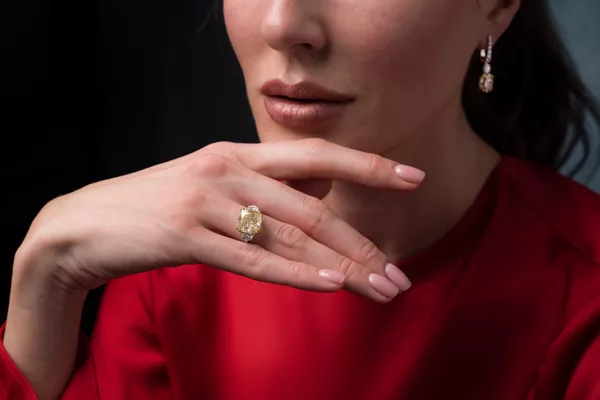


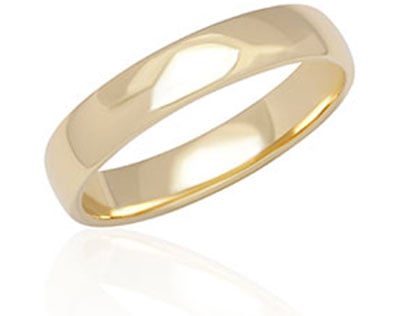




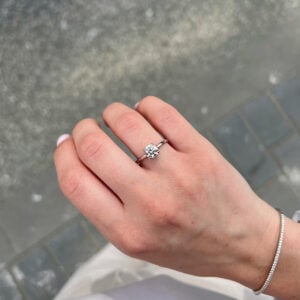
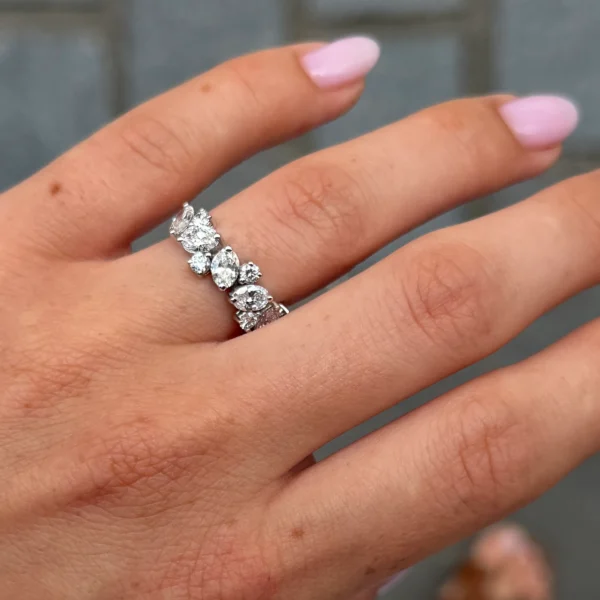


The same ring twice, one grade apart on each axis
We are offering two of these. Same 0.70 carat, same oval, same four claws, same 18K yellow gold, both GIA. The only differences are one step of colour, one step of clarity, and one hundred euro.
This one is E SI1 at €2,795. Its twin is D VS2 at €2,895. That is an unusually clean experiment, because everything that normally muddies a comparison — shape, weight, mount, metal, laboratory — is held constant. So the question is not abstract: what does one hundred euro buy here?
Face up, in a jeweller’s window or on a hand: nothing you can see. D and E are adjacent grades at the top of the colourless range, separated by an amount of tint that requires the stone to be turned upside down on a white card next to a master set. VS2 and SI1 are adjacent too — both are grades at which a trained eye finds inclusions under ten times magnification and your eye finds none. The hundred euro buys you two letters on a piece of paper and the knowledge that you are one notch higher. For some people that is worth it, which is a legitimate reason and not the same as a visible one.
Why E in yellow gold is a particularly easy decision
There is a second argument that applies to this ring and not to its white gold equivalents. The mount is yellow gold, and metal in contact with the pavilion returns its own colour up through the stone. A D diamond sitting in a yellow basket is being asked to stay colourless inside a warm frame, and it does not fully succeed — nor is it meant to.
That is not a flaw, it is the point of a yellow gold solitaire: the warmth of the metal and the brightness of the stone are supposed to play against each other. But it does mean the practical gap between D and E narrows almost to nothing once the stone is set. If you are buying a colourless diamond for a yellow mount, E is where the sensible money stops.
SI1 and VS2 are a magnification difference, not a looking difference
VS2 means inclusions that take a trained eye some effort to locate at 10×. SI1 means inclusions that the same eye finds without effort at 10×. Neither grade implies anything visible without a loupe in the great majority of stones, and at 0.70 carat an oval measures roughly 7 by 5 millimetres — there is not a great deal of real estate for anything to hide in or to show in.
What matters on an SI1 is placement, not the grade itself. An inclusion under the shoulder of an oval behaves differently from one sitting in the middle of the table. Ask us for the clarity plot before you decide: GIA report 6551474006. It takes us a minute to send and it answers the only question the letters leave open.
Specification
Centre stone 0.70 ct oval cut, colour E, clarity SI1, GIA report 6551474006. 18K yellow gold, four claws. In stock in our Antwerp workshop.