Nederlands
 Français
 Italiano
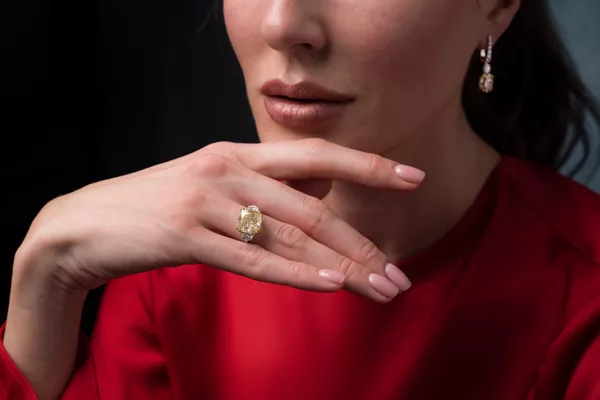

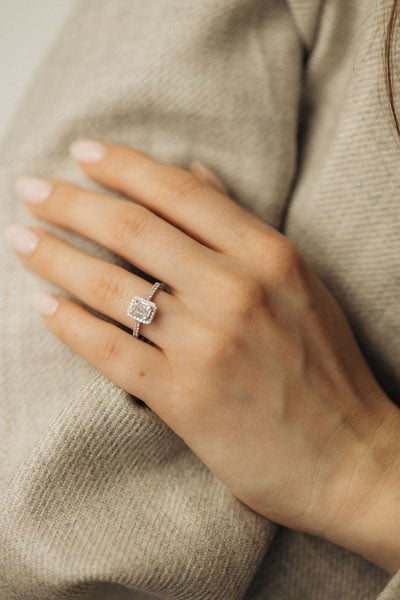

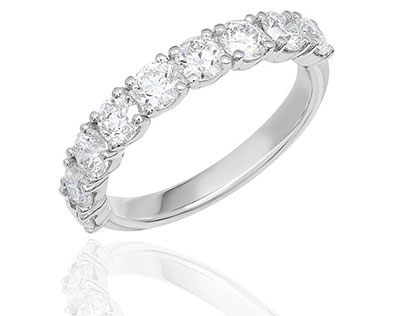

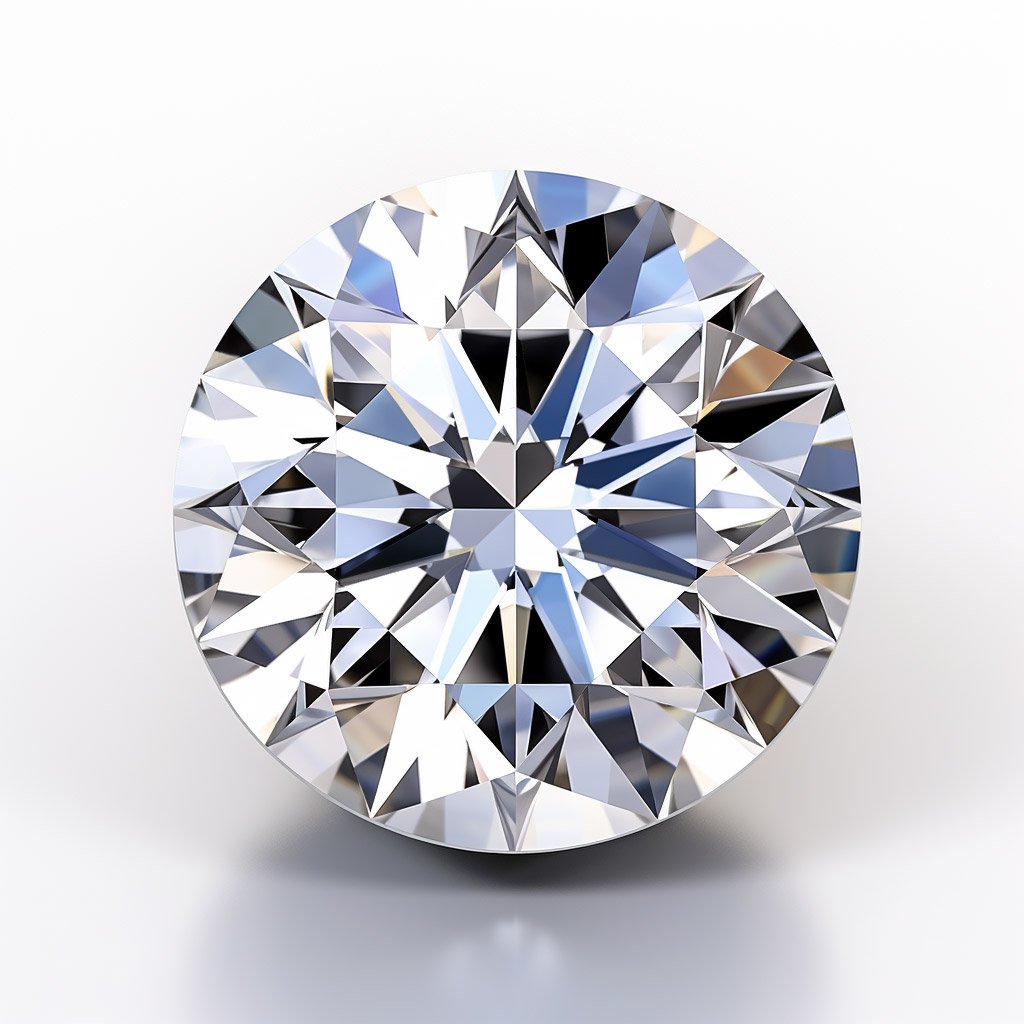



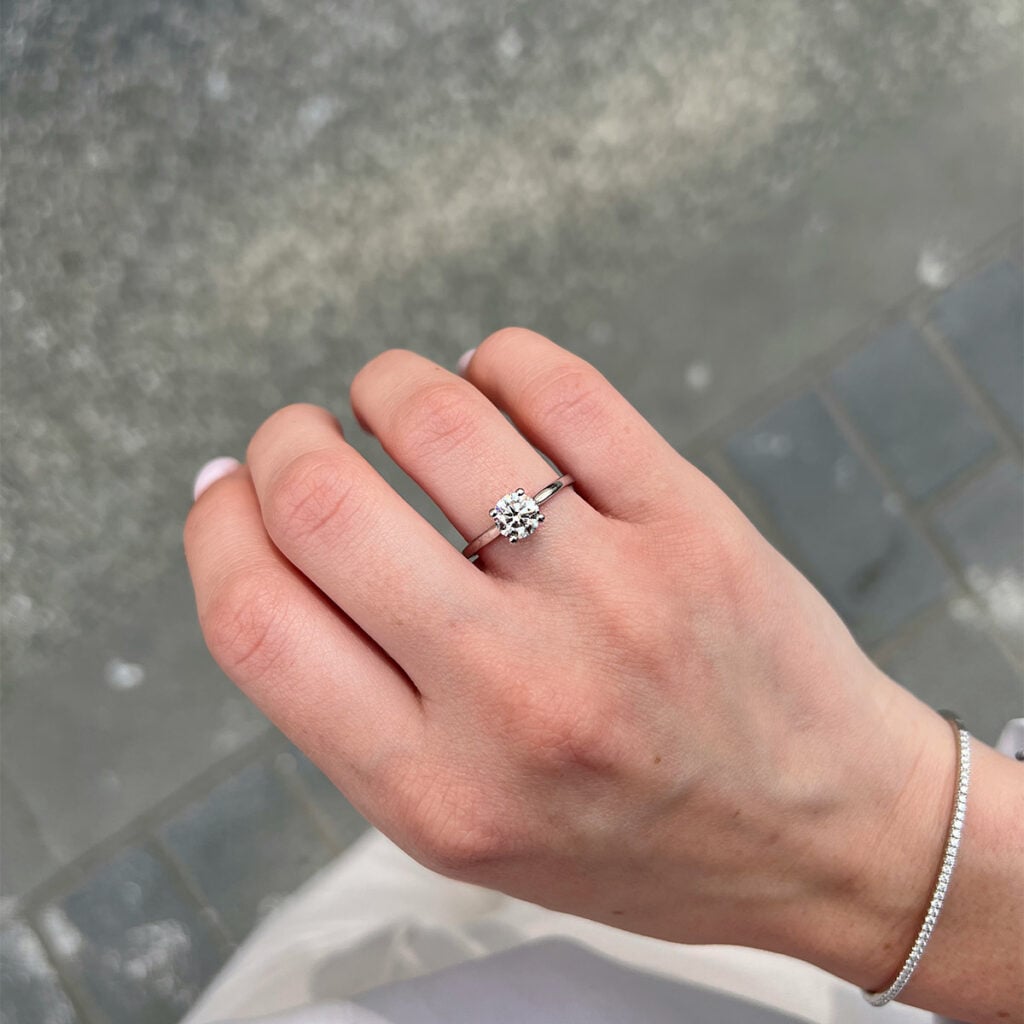
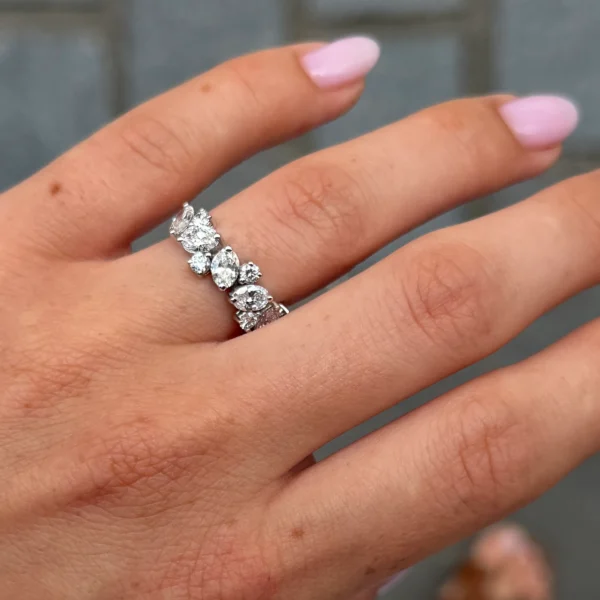


2.01 carats, oval cut, laboratory-grown, IGI certified D colour and VVS1 clarity, set above a hidden halo on a pavé band. The accent stones total 0.33 carat in D–F colour and VS clarity. 18K white gold. Report LG782611545.
A halo you can see changes the shape. This one does not
There is a reason people choose an oval, and it is the outline: a long, closed curve with no corners and no point, narrower than a round of the same weight and considerably longer. It is the silhouette that does the work.
A conventional halo takes that away. Ring an oval with round brilliants and the eye stops reading the oval and starts reading the halo’s outer edge — which, because the melee is a uniform size all the way round, is always closer to a rounded rectangle or a cushion than to the shape underneath it. The stone gets bigger and less itself. It is a perfectly good trade on a small centre, where apparent size is the whole point. On a two carat oval there is nothing to buy: the stone is already large, and what a visible halo would cost is precisely the thing worth keeping.
A hidden halo is the version of the idea that does not touch the silhouette. The small stones sit beneath the girdle, set into the outside of the basket and facing outward, so from above the outline is the oval’s own and nothing else. The halo does not interrupt the shape because, seen from the direction the shape matters, it is not there.
What the pavé adds that a plain band would not
This is the part specific to this ring rather than to hidden haloes in general, and it is worth looking at in profile.
A hidden halo on a plain shank produces a bright line of small stones that wraps the basket and then stops — the shoulders are polished metal, so the light ends abruptly where the halo ends. It reads as a detail: a band of brilliance around the setting, framed by plain gold. That is a legitimate design, and our 1.50 ct hidden halo on a plain band is exactly it.
Carry pavé down the shoulders instead and the two features join. The halo runs around the basket, the pavé runs down both sides, and in profile the ring has no dark segment anywhere along its upper half — one continuous circuit of small stones from shoulder to shoulder, passing under the diamond. The centre no longer sits on a ring; it sits at the high point of something unbroken.
It is also why the melee grade is worth checking on a design like this. At D–F and VS, the accents hold the same tone as the white gold around them and as the centre above them, so the circuit reads as one bright line rather than as thirty separate chips of varying colour.
It will need cleaning more often than a solitaire
Worth saying, because it is the practical consequence and it rarely gets mentioned.
A plain solitaire is close to self-cleaning: there is little to catch on, and the underside of the stone is open. A hidden halo combined with a pavé band is the opposite — dozens of small settings, most of them underneath the centre stone where hand cream, soap residue and skin oil collect and where you cannot see them doing it. The ring does not look dirty; it looks slightly less bright than it did, which is harder to notice and easier to live with for too long.
Warm water, a drop of washing-up liquid and a soft brush once a week handles it. An ultrasonic clean once or twice a year brings it back entirely. None of this is onerous, but a ring like this rewards the habit in a way a plain band does not.
The grades, and the stone
D is the top of the colour scale and VVS1 is one grade below flawless. On a mined oval of two carats that pairing belongs to a different price class altogether; on grown material it is a specification rather than a rarity, which is why it appears here at this weight and this price. It is a real diamond — crystallised carbon, hardness 10, graded by IGI on the same scales applied to mined stones. What is absent from the price is geological scarcity, and nothing else.
IGI report LG782611545. 18K white gold. Set and finished in Antwerp. One ring.
Nearby in the range
- 1.50 ct, hidden halo, plain white gold band — the same idea without the pavé.
- 1.59 ct, hidden halo and pavé, yellow gold — the same construction in a warm metal.
- 2.06 ct oval solitaire, white gold — the same weight class with nothing under the stone.