Nederlands
 Français
 Italiano
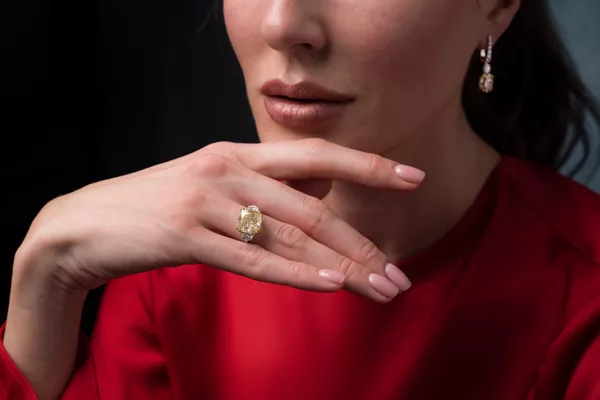

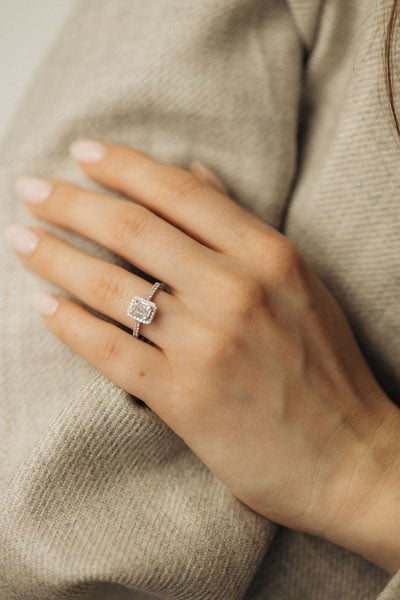





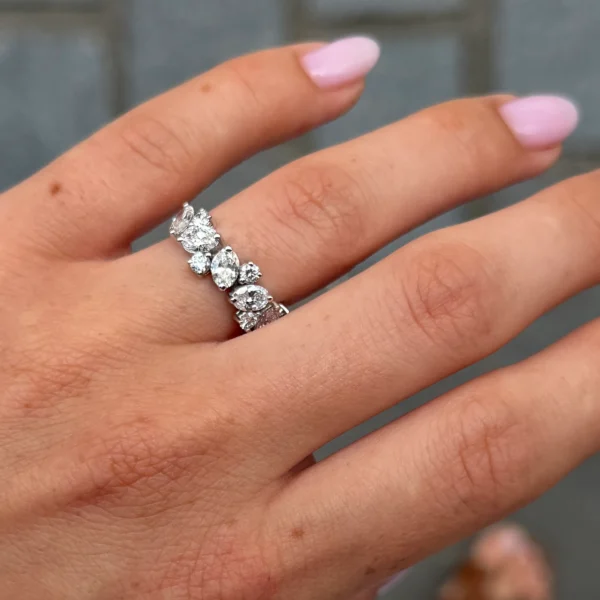


In a three stone ring the side stones are not decoration. They are doing a job, and which shape you choose decides how well they do it.
The pears here sit belly-in and point-out: the widest part of each pear sits against the oval, and the tip runs outward and down to meet the band. That orientation does the thing a three stone ring exists to do. The combined outline — wide at the centre, tapering at both ends — reads as one continuous shape rather than three objects in a row, and it stretches along the axis of the finger, which makes the whole head look longer and the centre stone look larger than it would standing alone.
Pears also solve the transition problem better than the alternatives. Round side stones leave a stepped silhouette where the head meets the shank; baguettes put straight edges against a curved centre. A pear has a curved belly that echoes the oval and a point that tapers to nothing, so the ring narrows gradually from its widest point down to the band with no visible join.
The side stones total 0.51 carat, roughly a quarter of the centre’s weight. That ratio matters: below about a fifth, side stones read as accents on a solitaire; at this proportion the ring is a genuine three stone, where the composition rather than the single stone is the point.
The centre is 2.06 carat, oval cut, IGI certified D colour and VS1 clarity under report LG770604986. The pears are graded D to E with VS clarity — held to within one grade of the centre, so there is no visible step in whiteness as the eye crosses from one stone to the next. On a three stone ring that matching matters more than the absolute grade, because the three stones are seen side by side and any difference between them is the one comparison a viewer can actually make.
Lab-grown diamonds throughout, 18K yellow gold, set and finished in Antwerp.