Nederlands
 Français
 Italiano

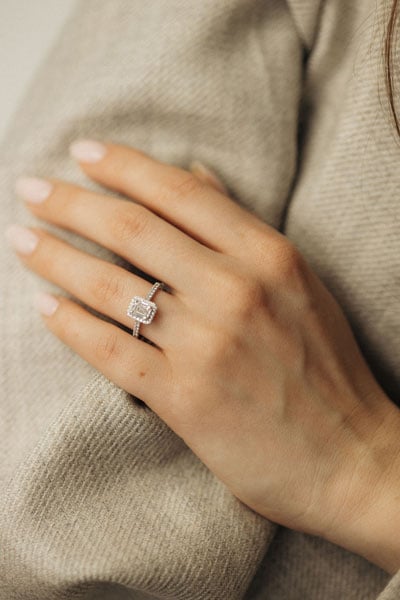





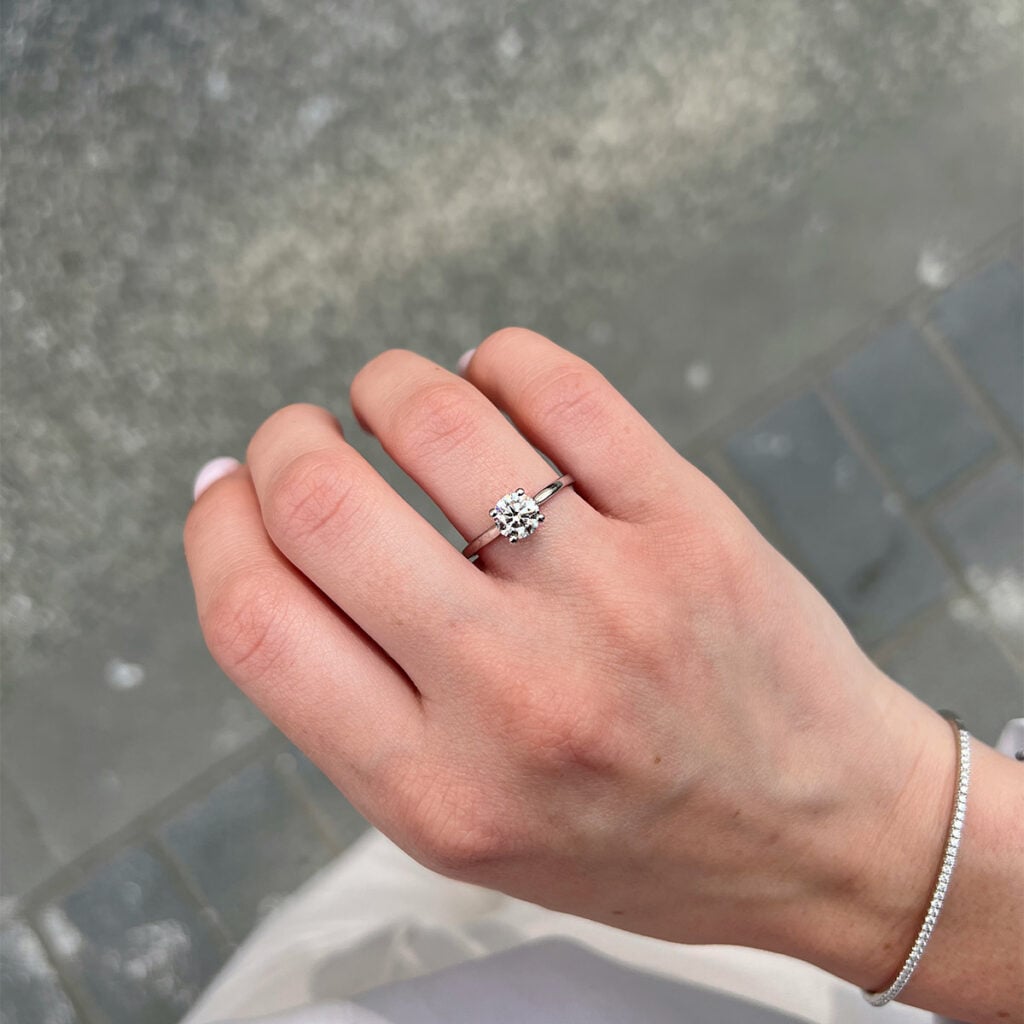
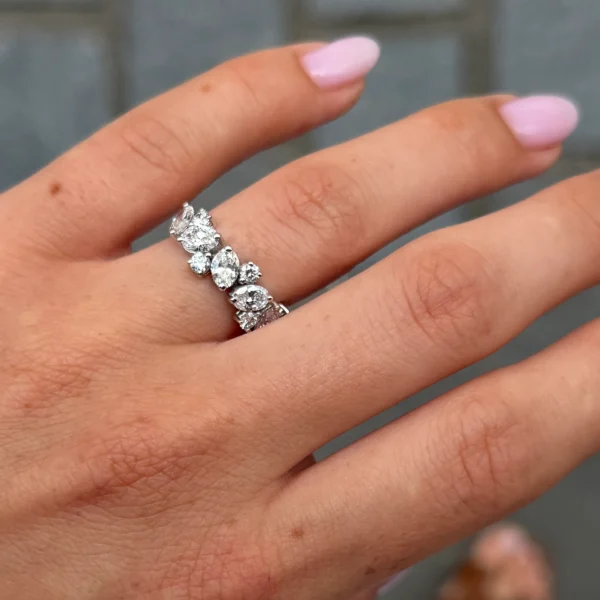


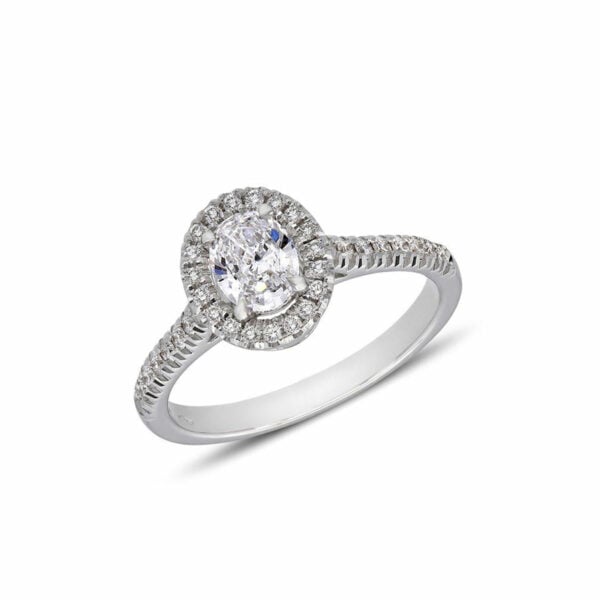
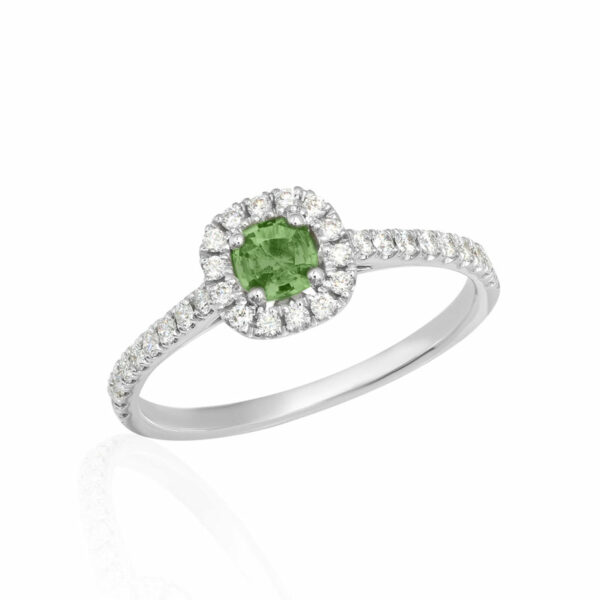
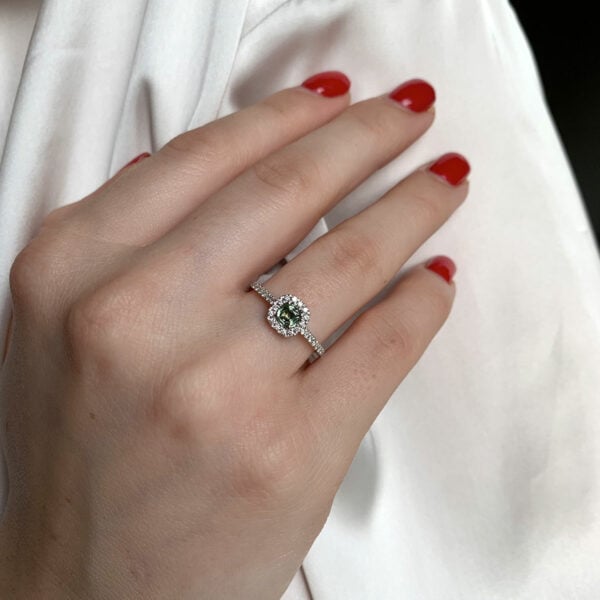
0.30 ct E VS2 with a halo and a pavé band, 18K white gold
A GIA-certified round brilliant of 0.30 carat, colour E, clarity VS2, held in four claws inside a halo of small brilliants, with the pavé continuing down the shoulders. 0.22 ct of D–F side stones in total. Report 6541002340. 18K white gold.
The arithmetic of a halo at three tenths of a carat
A halo does not make a diamond bigger. It makes the cluster bigger, and the leverage it gets depends entirely on how small the centre is.
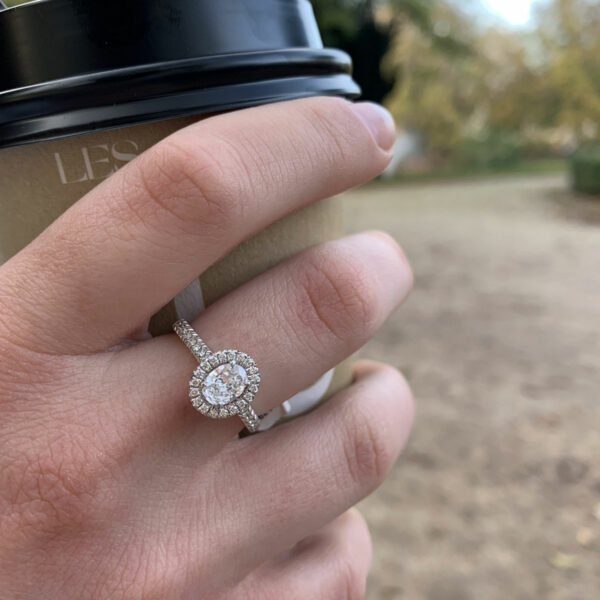
The numbers here: a 0.30 ct round brilliant measures about 4.3 mm across. Ring it with melee of roughly 1.1 to 1.3 mm and you add that diameter twice, once on each side — so the outline reaches about 6.5 to 6.9 mm. A one-carat round brilliant is 6.4 mm. At conversational distance, that is the size the ring occupies.
Now apply the same halo to a one-carat centre: 6.4 mm becomes roughly 8.6 mm, an increase of a third rather than a half. The halo has done the same work in millimetres but far less in proportion. That is why halos cluster at the lower carat weights — the smaller the centre, the more the surround is worth.
How to tell a well-made halo from a cheap one
Look at the join. In a good halo the melee is set tight against the centre stone’s girdle, so the two rows of brilliance run into each other and the eye reads a single mass. In a poorly made one there is a visible ring of metal between the centre and the surround, and at that point the illusion collapses: you no longer see a big stone, you see a small stone with a fence around it.
That gap is where cost gets cut, because closing it means seating stones of slightly different sizes against a curve without chipping either row. It is worth putting the ring under a light and looking at the boundary before you judge any halo, ours included.
Why VS2 rather than higher
At 4.3 mm, an inclusion has to be substantial to be visible without magnification, and VS2 means it is not. Spending up the clarity scale on a centre this size buys certificate lines, not appearance. Colour E is the grade doing visible work, and it matters more here than usual: the centre is surrounded by D–F melee, so any warmth in the centre stone would be measured directly against the stones touching it. A lower colour grade in the middle of a colourless halo is immediately obvious.
Specification
- Centre stone: natural diamond, round brilliant, 0.30 ct, colour E, clarity VS2, four claws
- Certificate: GIA 6541002340
- Side stones: natural diamonds, 0.22 ct total, D–F colour, halo and pavé
- Metal: 18K white gold
The other way to make a small stone read large
A halo adds width. A raised, curved shank adds height instead — see the 0.30 ct intertwined band ring in 18K yellow gold, the same centre weight solved the opposite way. Both sit in engagement rings.
Buying from Antwerp
In stock at our workshop in the Antwerp diamond district. Shipped insured, boxed, with the GIA report. The shoulders are pavé set, so this ring can be sized about one size in either direction — tell us the finger size before ordering.